
How to Prepare for the NTS GAT General Test in Pakistan (2026 Guide)
If you are planning an MPhil, MS, or PhD-track programme in Pakistan, there is one gatekeeper standing between you and admission: the Graduate Assessment Test, or GAT, conducted by the National Testing Service (NTS). Almost every public and private university in the country requires a valid GAT General score for graduate admissions, and HEC scholarships and fellowships ask for it too. The good news is that the GAT General is not a test of how much you know — it is a test of how you think under time pressure. It has 100 multiple-choice questions, a fixed pattern that barely changes, and no subject-specific syllabus to memorise. With eight weeks of the right kind of practice, a score of 60+ is entirely realistic for a disciplined graduate. This guide breaks down the pattern, the three sections, the registration process, and a week-by-week plan to get you there.
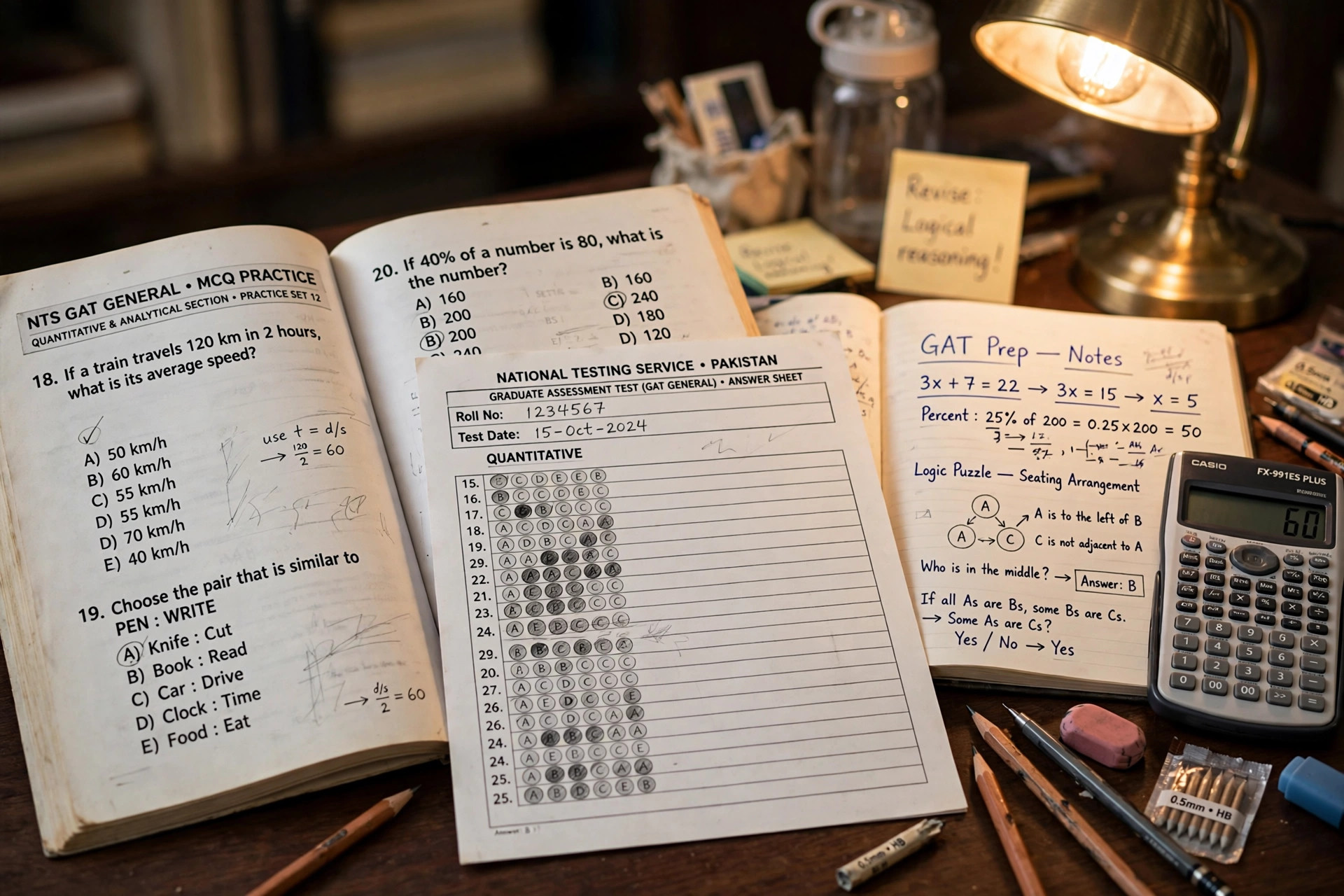
What Is the GAT General and Who Needs It
NTS conducts several tests — NAT for undergraduate admissions, GAT General for Master's and MPhil admissions, and GAT Subject for PhD admissions and some recruitment. Do not confuse them: if your goal is an MS or MPhil, you need the GAT General. Universities use it as a standardised measure of verbal reasoning, quantitative reasoning, and analytical ability, so that a graduate from Peshawar and a graduate from Karachi can be compared on the same scale. HEC recognises NTS tests for this purpose, and most admission advertisements mention the GAT requirement explicitly. The score is generally valid for two years, which means many students take the test in their final undergraduate semester and apply to programmes months later. Always confirm the current validity and minimum-score rules on the official NTS announcement, because policies are updated periodically.
The Test Pattern: 100 MCQs in 120 Minutes
The GAT General is a paper-based test: 100 multiple-choice questions, 100 total marks, 120 minutes on the clock — a little over one minute per question. Each question has four or five answer options, and the questions fall into eight types grouped under three sections: Verbal Ability, Quantitative Ability, and Analytical Ability. NTS offers the test about four times a year at centres in major cities across Pakistan, and registration happens through the NTS online portal with the fee stated in each test announcement. One feature works strongly in your favour: the GAT General does not carry negative marking, so a wrong answer costs you nothing more than a skipped one — attempt every single question. (Confirm this on your roll number slip on the day, since session rules are the final authority.)
Section 1: Verbal Ability — Where Vocabulary Pays
The verbal section tests English language and reasoning, not literature. The question types are remarkably stable: synonyms (choose the closest meaning), antonyms (choose the opposite), analogies (PEN : WRITE is like KNIFE : CUT — find the matching relationship), sentence completion (fill the blank with the word that fits the logic of the sentence), and reading comprehension (answer questions about a short passage). Pakistani graduates typically find analogies and sentence completion the most trainable and reading comprehension the most time-consuming. The winning strategy here is twofold: build a working vocabulary of the high-frequency GAT word list (roughly 1,000–1,500 words recur across sessions), and practise reading the comprehension passage's questions before reading the passage, so you know what to look for. Ten new words a day, learned in sentences rather than in isolation, beats cramming a dictionary the week before.
Section 2: Quantitative Ability — Matric Maths, Exam Speed
The quantitative section tests mathematics up to FSc and mostly matric level: percentages, ratios and proportions, averages, age and work problems, basic algebra (linear equations, factorisation), geometry (areas, angles, triangles), number series, and data interpretation from simple charts. No calculus, no trigonometry beyond basics — the difficulty is the speed, not the concepts. Almost every question is solvable in under 90 seconds if you recognise the type, which is why drilling standard question types matters more than relearning theory. Learn the shortcut methods: percentage-to-fraction conversions (25% = 1/4, 12.5% = 1/8), ratio splitting, the unitary method for work problems, and plugging answer choices back into equations when algebra stalls. Candidates from engineering, CS, and commerce backgrounds usually treat this as their scoring section; arts and humanities graduates should simply start this section's preparation first, since it has the steepest learning curve for them.
Section 3: Analytical Ability — The Section That Decides Ranks
The analytical section is where strong students separate from average ones. It has two flavours. Analytical reasoning gives you a set of conditions — seating arrangements, ordering puzzles, grouping rules — followed by several questions about what must or could be true. Logical reasoning asks you to evaluate arguments: what strengthens or weakens a conclusion, what assumption the argument depends on, what can be inferred. Most Pakistani candidates have never seen these question types before, so the first encounter feels alien — and that is exactly why preparation pays off disproportionately here. The method for analytical puzzles is mechanical: draw the diagram, list the constraints, and work through the questions systematically instead of re-reading the conditions each time. For logical reasoning, learn the handful of argument patterns (cause-and-effect, generalisation, analogy) and the standard trap answers. Twenty puzzles a day for three weeks transforms this section from a mystery into a reliable marks bank.
How to Register: The Practical Steps
Registration for the GAT General runs through the NTS online portal (www.nts.org.pk). The flow is the same each session: create an account on the portal, select the GAT General test, fill in the application form with your personal and academic details, and pay the fee stated in the current test announcement — the fee changes between announcements, so check the latest one rather than relying on an old figure. After payment and verification, download your roll number slip from the portal before the test date, print it, and bring it with your original CNIC to the test centre listed on it. Choose your test centre carefully during registration; NTS conducts the test in major cities, and seats at popular centres fill up. Two details candidates get wrong every session: the name and CNIC number on the form must match your legal documents exactly, and mobile phones are not allowed inside the test centre — plan accordingly.
Passing Marks, Score Validity, and Retakes
HEC's general requirement is a minimum of 50 out of 100 marks in the GAT General for graduate admission — but treat 50 as the floor, not the target. Competitive MPhil and MS programmes in popular departments shortlist at 60+, and merit-based HEC scholarships go higher still. Aim for 65 or above and you will be comfortable almost everywhere. The score is generally valid for two years, so you can take the test while finishing your degree and apply in the next admission cycle. There is no limit on attempts: if your first score disappoints, register for the next session (roughly three months later) and try again. Universities consider the score you submit with your application, so a retake never erases or harms a previous result — the only cost is the fee and the preparation time.
The 8-Week Preparation Plan
This plan assumes 2–3 focused hours a day. Adjust the pace, not the sequence.
- Weeks 1–2: Learn the question types. One section at a time — verbal in week 1, quantitative and analytical in week 2. Solve untimed practice sets and study every solution, right or wrong. Build a notebook of formulas, vocabulary, and puzzle methods.
- Weeks 3–4: Timed section practice. Start solving section-wise sets under time limits — slightly tighter than the real pace. Begin your daily 10-word vocabulary routine and one reading passage every other day.
- Weeks 5–6: Mixed practice and weak-spot repair. Solve mixed question sets that jump between sections, like the real paper. Keep an error log: every mistake gets the question type, the correct method, and a one-line reminder. Re-solve your error log weekly.
- Weeks 7–8: Full mock papers. Two to three full 100-question, 120-minute papers per week under real conditions — no phone, bubble sheet, seated at a desk. Analyse each mock the same day: where did time leak, which question types still break, and what changes next time?
The error log is the engine of this plan. Students who review their own mistakes improve dramatically faster than students who only solve fresh questions, because you are fixing your actual weak patterns — misread conditions, arithmetic slips, analogy traps — not generic ones.
Test-Day Strategy
- Bank time early. The verbal section's synonyms and antonyms are the fastest marks on the paper — clear them quickly and carry the saved minutes into comprehension and analytical puzzles.
- Attempt everything. With no negative marking, a blank is a guaranteed zero while a guess has a 20–25% chance. In the last five minutes, bubble every unanswered question.
- Do not get stuck. If a puzzle resists for more than two minutes, mark it, move on, and return with fresh eyes. One stubborn question must never cost you three easy ones.
- Bubble as you go. Fill the answer sheet question by question rather than transferring answers at the end — transcription errors under time pressure are a classic, silent score-killer.
- Read analytical conditions once, properly. A careful first read with a drawn diagram beats three rushed re-reads. The questions that follow one puzzle share the same setup.
- Carry the basics. Printed roll number slip, original CNIC, pencils, eraser, and a simple watch if allowed — and reach the centre early enough that traffic cannot ruin your morning.
Common Mistakes Pakistani Candidates Make
- Preparing like a board exam. The GAT tests reasoning under time pressure, not memorised content. Reading theory for weeks without timed practice is the most common way to fail.
- Ignoring the analytical section. Because it feels unfamiliar, candidates postpone it — then lose the section that separates the merit list from the rest. Start analytical puzzles in week one.
- Vocabulary cramming without sentences. A word learned alone is forgotten in a week. Learn every new word in a sentence, and revise the week's words every Sunday.
- Skipping mock papers. The jump from untimed practice to a 120-minute paper is brutal the first time. Your first mock should be a disaster — privately, at home — never at the real test centre.
- Registering late. Late registration means an inconvenient test centre or a missed session. Register as soon as the announcement drops; preparation and paperwork should never compete.
- Applying with a bare-minimum 50. Fifty clears the HEC floor but rarely clears departmental merit. If your target programme is competitive, plan a retake rather than hoping the merit list drops to you.
Frequently Asked Questions
What is a good score in the NTS GAT General test?
The HEC generally requires a minimum of 50 out of 100 marks, but competitive MPhil and MS programmes shortlist at 60 or above, and top programmes higher still. Treat 50 as the floor and 65+ as a genuinely strong score. Confirm the current minimum and validity rules on the official NTS announcement before you register.
How many times can I attempt the GAT General test?
There is no limit on attempts. NTS holds the GAT General about four times a year at centres across Pakistan, so you can retake it at the next session if your score is short. Universities use the valid score you submit with your admission form, so a retake never hurts a previous result.
Is the GAT General difficult for students weak in mathematics?
The quantitative section tests matric and FSc-level mathematics — percentages, ratios, algebra, basic geometry — not university-level maths. Arts and humanities graduates routinely score well by drilling the standard question types. Since verbal and analytical sections reward reading and logic, weak math students can still reach a strong total.
Does the GAT General have negative marking?
The GAT General paper does not carry negative marking — an unanswered question and a wrong answer both score zero, so you should attempt every question. Always double-check this on your roll number slip and the printed instructions on test day, because NTS rules can change between sessions.
How long is the GAT General score valid?
HEC policy treats a GAT General score as valid for two years, which is why many graduates take the test in their final semester and apply later. Verify the validity period in the admission criteria of the specific university and programme you are applying to.
Can I prepare for the GAT General in one month?
Yes, if you study 2–3 focused hours daily: two weeks on question-type mastery (one section at a time), one week on timed mixed practice, and one week on full-length mock papers with error review. A month is tight for the verbal section's vocabulary, so extend to 8 weeks if you can.
One last principle: the GAT General rewards preparation more honestly than almost any exam in Pakistan, because the pattern never changes and there is nothing to memorise — only skills to build. The graduates who score 70+ are not the cleverest in the room; they are the ones who solved the most puzzles, timed the most papers, and reviewed the most mistakes. Eight weeks of that, and the test becomes a formality on the way to your MPhil. Start tonight: one analytical puzzle, ten new words, and twenty quantitative MCQs.
Seekho Learn Editorial Team — practical guides for students and young professionals.