
How to Join Pak Army After Intermediate (2026): PMA Long Course 159 Eligibility, Tests & the Full Selection Process
Every year, thousands of FSc and FA students in Pakistan dream of the olive-green uniform — and every year, most of them lose the race before it starts: they hear about the induction too late, misread the eligibility, or walk into the initial test with zero preparation. This guide fixes that, and the timing could not be more urgent — PMA Long Course 159 registration is open right now and closes on October 23, 2026. Below you will find the exact eligibility for intermediate candidates, the step-by-step online registration on joinpakarmy.gov.pk, and a walkthrough of the full selection chain: computer tests at the AS&RC, the physical test, preliminary medical, initial interview, the 4-day ISSB, final medical at CMH, and two years of training at PMA Kakul. If you have just finished intermediate and you are serious about the Army, read this today and act this week.
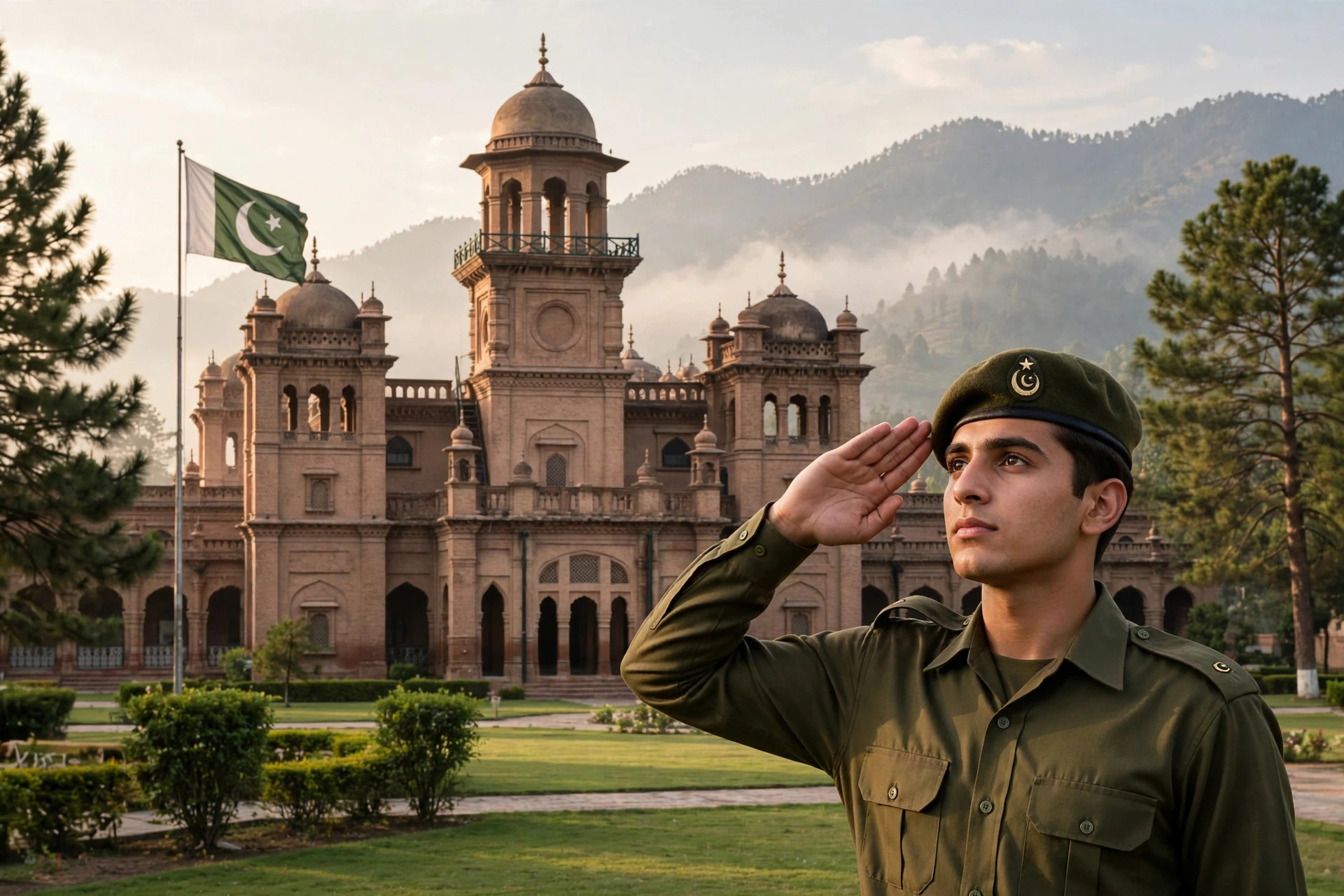
1. Why the Army Right After Intermediate Is a Serious Career Move
Before the details, the question every family asks: is joining the Army straight after FSc a sensible career in 2026? For the right candidate, yes — and the reasons are practical. A commissioned officer enters government service at around 19 or 20 with a defined pay scale, free medical treatment for self and family, accommodation, and a pension. Few routes turn an intermediate certificate into an officer's commission in two years of training, and the leadership and management experience compounds for life, in uniform or out. (Comparing it with universities, CSS, and other paths? Our career options after intermediate guide lays them side by side.)
The honest flip side: it is ruthlessly competitive. Tens of thousands apply for a few hundred seats per course, and the selection system filters at every stage — intelligence test, physical, medical, ISSB. Preparation is not optional here; it is the whole game. This guide is built for that reality.
2. PMA Long Course 159: The 2026 Cycle Open Right Now
The Pakistan Army runs the PMA Long Course twice a year, and the current intake is PMA Long Course 159 — the 159th batch of the officer training program. The key dates for this cycle:
- Online registration: September 14 to October 23, 2026 — on the official portal joinpakarmy.gov.pk only.
- Initial tests: October 5 to December 15, 2026, at Army Selection and Recruitment Centres (AS&RCs) across the country.
- Training: two years at the Pakistan Military Academy, Kakul, after final selection.
If you are reading this after October 23, 2026, this window has closed — but the course returns roughly every six months, so the next intake (PMA 160) is the one to prepare for. One critical rule that never changes: the Army's only official recruitment website is joinpakarmy.gov.pk — an address ending in .gov.pk. Fake pages impersonating it appear around every induction, so type the address yourself and never trust a WhatsApp forward.
3. Eligibility Checklist: Do You Qualify?
Eligibility comes straight from the official advertisement — the figures below are from the PMA 159 ad, and they stay stable from course to course, but always re-check the current ad before applying:
- Nationality and gender: male citizen of Pakistan, with domicile from any province — including Azad Jammu and Kashmir and Gilgit-Baltistan. (Candidates holding dual nationality must surrender the foreign citizenship if selected.)
- Age (as of 1 May 2027): 17 to 22 years for intermediate (FA/FSc) candidates. Two-year graduates and serving Pakistan Navy/Air Force personnel: 17 to 23. Four-year degree holders (BS, BA Hons, BBA, BPA): 17 to 24. Serving Army soldiers: 17 to 25.
- Marital status: unmarried — except married serving armed forces personnel over 20 years of age.
- Education: FA/FSc or equivalent (ICS, ICom, DAE all count) with at least 60% marks in aggregate.
- Height: minimum 5 feet 4 inches (162.5 cm), measured barefoot at the selection centre. Weight must meet BMI standards.
- Vision: distance vision 6/9 and 6/12 with glasses; near vision J2, J7, N8, N12 — with or without glasses.
The 60% means your overall intermediate aggregate, not your best subjects. And the age is calculated as of 1 May 2027, not the registration date — check your birth date against that cutoff honestly before you invest months of preparation.
4. Who Gets Relaxation: 55%, Graduates, Soldiers and Hope Certificates
Not everyone fits the standard 60% box, and the Army's advertisement accounts for that:
- 55% relaxation: candidates holding domicile of specified underdeveloped areas — Balochistan, Gilgit-Baltistan, Chitral, Dir, Kohistan, Tharparkar, and Rajanpur — can apply with 55% marks in intermediate.
- Two-year graduates: 60% marks in graduation plus 50% in intermediate, age 17 to 23.
- Four-year degree holders: 60% in BS, BA (Hons), BBA, or BPA, age 17 to 24.
- Serving Army soldiers: 50% in FA/FSc, age 17 to 25.
- Result awaited: if your Intermediate Part-II result is not out yet, you can apply with a Hope Certificate issued by the head of your institution.
- Foreign qualifications: O/A-level students need an IBCC equivalence certificate — arrange it early, because IBCC processing takes weeks.
5. How to Register Online: Step by Step
Registration happens only on joinpakarmy.gov.pk, and the flow is the same every course. With the deadline days away, do this now:
- Open joinpakarmy.gov.pk, click Apply Now, and select PMA Long Course 159.
- Fill the form carefully: name, father's name, date of birth, CNIC or Form-B number, domicile, and educational record with your exact percentage must match your documents. If your result is pending, select "Result Awaited".
- Upload a 1x1 passport-size photograph — formal dress, plain blue or white background, JPEG under 300 KB.
- Select your preferred test centre (AS&RC) and submit the form.
- After 5 to 7 working days, check Registration Status on the portal with your CNIC, then download your roll number slip and fee challan — the challan is paid at a National Bank of Pakistan branch.
Two practical warnings: the portal slows to a crawl near the deadline, so register days before October 23, not on it; and keep a documents file ready now — original matric and intermediate certificates with detailed mark sheets (attested), CNIC or Form-B, three passport photos attested by a Grade 16 officer, and your domicile — because you will carry it to the selection centre.
6. The Initial Tests at the AS&RC: Intelligence Is the Gatekeeper
On your test date you report to your chosen Army Selection and Recruitment Centre — there are AS&RCs in Rawalpindi, Lahore, Karachi, Peshawar, Quetta, Gilgit, Hyderabad, Multan, D.I. Khan, Muzaffarabad, Faisalabad, Khuzdar, and Pano Aqil. You sit a computer-based test with two parts, and the first one decides whether you ever see the second:
- Intelligence test (verbal + non-verbal): roughly 100 MCQs in about 35 to 40 minutes, with passing marks around 60%. Verbal questions cover analogies, series, and logical word problems; non-verbal questions use figures, patterns, and spatial reasoning. Fail this section and the academic tests stay locked — it is the single biggest filter in the process.
- Academic tests: subject MCQs drawn from your FSc syllabus — typically English and Mathematics plus general subjects — around 50 to 75 questions per subject in about 40 minutes.
What surprises first-timers: the test is timed aggressively (well under 25 seconds per intelligence question) and the difficulty is FSc-level, not CSS-level — candidates fail on speed, not knowledge. Practice with timed MCQ sets daily until the clock stops scaring you. The English grammar guide is worth your time too, since weak grammar bleeds marks in the academic section. (The PAF runs a nearly identical gatekeeper — see our PAF joining guide if you are weighing both forces.)
7. The Physical Test: 1.6 km in 8 Minutes
Clear the computer tests and you face the physical standards the same cycle. For PMA 159, the benchmarks are:
- 1.6 km run: in 8 minutes
- Push-ups: 15 in 2 minutes
- Sit-ups: 20 in 2 minutes
- Pull-ups: 3 in 2 minutes
- Ditch crossing: 7 feet 4 inches wide
The honest truth: the run eliminates more candidates than any written test. An FSc student who has never run seriously cannot fake 1.6 km in 8 minutes on the day — it takes weeks of buildup. Start running today, add distance gradually, and train push-ups, sit-ups, and pull-ups alongside. Also check your weight against BMI standards honestly before applying; the medical measures what the mirror hides.
8. Preliminary Medical and the Initial Interview
Alongside the tests, you go through a preliminary medical at the AS&RC: height and weight measurement, eyesight check against the 6/9–6/12 standard, and a basic physical examination. Fix known issues before you apply — get your eyes tested by a specialist now rather than discovering a problem at the centre.
Then comes the initial interview with Army officers. It is short and conversational — they assess confidence, communication, motivation, and general awareness (why the Army, why now, basic current affairs). Dress formally, know every detail of your own application, read the headlines for two weeks before, and answer in clear English or Urdu without reciting memorized speeches. Our exam stress guide has techniques that work just as well on interview morning.
9. ISSB: The 4-Day Officer Assessment
Pass the initial stages and you are called for the ISSB (Inter Services Selection Board) — the famous multi-day assessment all three services use for officers. ISSB centres operate at Kohat, Gujranwala, Malir (Karachi), and Quetta. You live at the centre for four days and go through:
- Psychological tests: written personality assessments, word association, story writing, and situation reactions — designed to reveal your real temperament, not rehearsed answers.
- Group planning and outdoor tasks: command tasks, group discussions, and physical obstacles testing teamwork, initiative, and leadership under pressure.
- Interviews: including a deputy president's interview probing your background, academics, and motivation.
The honest truth about ISSB preparation: you cannot cram for it. ISSB selects personality traits — confidence, honesty, initiative, teamwork — built over months. Live like a candidate: stay fit, read widely, take responsibility in group settings, practice expressing opinions clearly. And ignore any academy selling "guaranteed ISSB selection" — the board has seen every trick, and the fee is better spent on books and running shoes.
10. Final Medical at CMH and GHQ's Final Merit
ISSB-recommended candidates face the final, detailed medical at the Combined Military Hospital (CMH) — a multi-specialty screening far more thorough than the preliminary check. Minor issues that slipped through earlier get caught here, which is why the advice to fix health problems before applying keeps repeating.
The final merit list is compiled at GHQ, combining your performance across every stage — academics, initial tests, ISSB recommendation, and medical fitness. Merit order decides who receives the call letter and who lands on the waiting list. If you are waitlisted, keep your fitness and documents ready: vacancies open when recommended candidates drop out for medical or personal reasons.
11. Two Years at PMA Kakul: From Cadet to Second Lieutenant
Selected candidates report to the Pakistan Military Academy, Kakul — in the hills near Abbottabad — for two years of training. This is a full military academy program: drill, physical training, weapons training, academics, and service subjects, designed to turn a teenager into an officer. Cadets receive a monthly stipend during training.
You pass out as a Second Lieutenant — a commissioned officer of the Pakistan Army with a permanent commission. From there, officers join their assigned arms and services and continue professional military education throughout their careers. The commission, the training, and the network are real and permanent; that is what makes the two hard years worth it.
12. Disqualifications and the Fee-Fraud Warning
Two hard rules end candidacies permanently, so know them before you start:
- Rejected twice by ISSB ("twice not recommended") — you can never apply for a commission again.
- Failed the initial test three times — also permanently ineligible.
And a warning that matters every single course: the Army collects its fee only through the NBP challan you download after registration. Anyone asking you to send money via JazzCash, Easypaisa, or a personal bank account — or offering to "confirm your seat" for cash — is a scammer. The Army's only website is joinpakarmy.gov.pk, and no officer or agent will ever ask for money on WhatsApp. Report fraud attempts to the Join Pak Army help desk at 051-5686225.
13. Your Action Plan: Days to the Deadline
With registration closing on October 23, 2026, there is no time for a leisurely six-month plan. Do this now:
- Today: check eligibility honestly — age as of 1 May 2027, intermediate percentage, height. If you qualify, register on joinpakarmy.gov.pk today, not next week.
- This week: assemble the documents file (section 5), download your roll number slip, and pay the challan at NBP. Start running — even a few sessions before the test date help.
- Until your test date: daily timed intelligence-test MCQ practice (speed first, accuracy follows), FSc English and Maths revision, and progressive physical training toward the section 7 benchmarks.
- Alongside: keep a parallel plan. Apply to universities and prepare for entry tests like ECAT too — a backup plan is not weak commitment, it is thinking like an officer. Organize all of it with proper time management.
One last thing: if you missed this window, do not wait for a WhatsApp forward to tell you about the next one. The course runs roughly twice a year — note the pattern, check joinpakarmy.gov.pk regularly, and spend the gap months on the one thing that decides most candidacies: timed intelligence-test practice and running shoes.
Frequently Asked Questions
Can I join the Pak Army after intermediate with less than 60% marks?
Generally no, with one official exception: candidates holding domicile of specified underdeveloped areas — Balochistan, Gilgit-Baltistan, Chitral, Dir, Kohistan, Tharparkar, and Rajanpur — can apply with 55% marks in intermediate. Graduates have their own route: 60% in the degree plus 50% in intermediate.
What is the age limit for PMA Long Course 159 after FSc?
For intermediate (FA/FSc) candidates, the age limit is 17 to 22 years as of 1 May 2027. Two-year graduates and serving Pakistan Navy or Air Force personnel get 17 to 23 years, four-year degree holders get 17 to 24 years, and serving Army soldiers get 17 to 25 years.
Can girls join the Pak Army as officers after intermediate?
The PMA Long Course is male-only, but female students have their own officer routes: the Armed Forces Nursing Service (AFNS) accepts females after FSc Pre-Medical, and the Lady Cadet Course (LCC) inducts female graduates and postgraduates as officers. Both are announced separately on joinpakarmy.gov.pk — watch for those announcements rather than assuming any single ad is the final word.
What happens if I fail the initial intelligence test?
Failing the intelligence test ends your attempt for that course, since the academic tests stay locked and you cannot re-sit within the same course. It does not ban you forever — you may apply again in a later PMA course. But note the hard limits: three failed initial attempts, or two ISSB rejections, make you permanently ineligible, which is why starting timed practice early is the highest-value preparation you can do.
Is there a fee to apply for PMA Long Course 159, and how do I avoid fraud?
The only legitimate payment is the fee challan deposited at a National Bank of Pakistan branch after online registration. The Army never collects fees through JazzCash, Easypaisa, or personal bank accounts, and no one can "confirm your seat" for cash. Report fraud attempts to the Join Pak Army help desk at 051-5686225.
What rank do you get after completing PMA training?
After two years of training at the Pakistan Military Academy, Kakul, cadets pass out and are commissioned as Second Lieutenants with a permanent commission in the Pakistan Army. Cadets receive a monthly stipend during the two years of training.
Seekho Learn Editorial Team — practical guides for students and young professionals.