
DAE After Matric in Pakistan: Admission, Best Technologies, Fees, Scope & Jobs (2026 Guide)
Matric done, and everyone is pushing you toward FSc — but there is a fourth option most families barely discuss: DAE, the Diploma of Associate Engineer. It is a three-year technical diploma taken right after matric, taught in government colleges of technology and polytechnics across Pakistan, and it produces something FSc rarely does — a graduate who can do a skilled job on day one. Electricians who read drawings, mechanics who run CNC machines, technicians who wire control panels: that is what a DAE makes. This guide covers what the DAE actually is, who should take it, the best technologies in 2026, how admission works through TEVTA and the technical boards, the real fees and waivers, how it compares with FSc, the jobs and salaries after it, and the higher-study routes — everything a matric student needs before admission season.
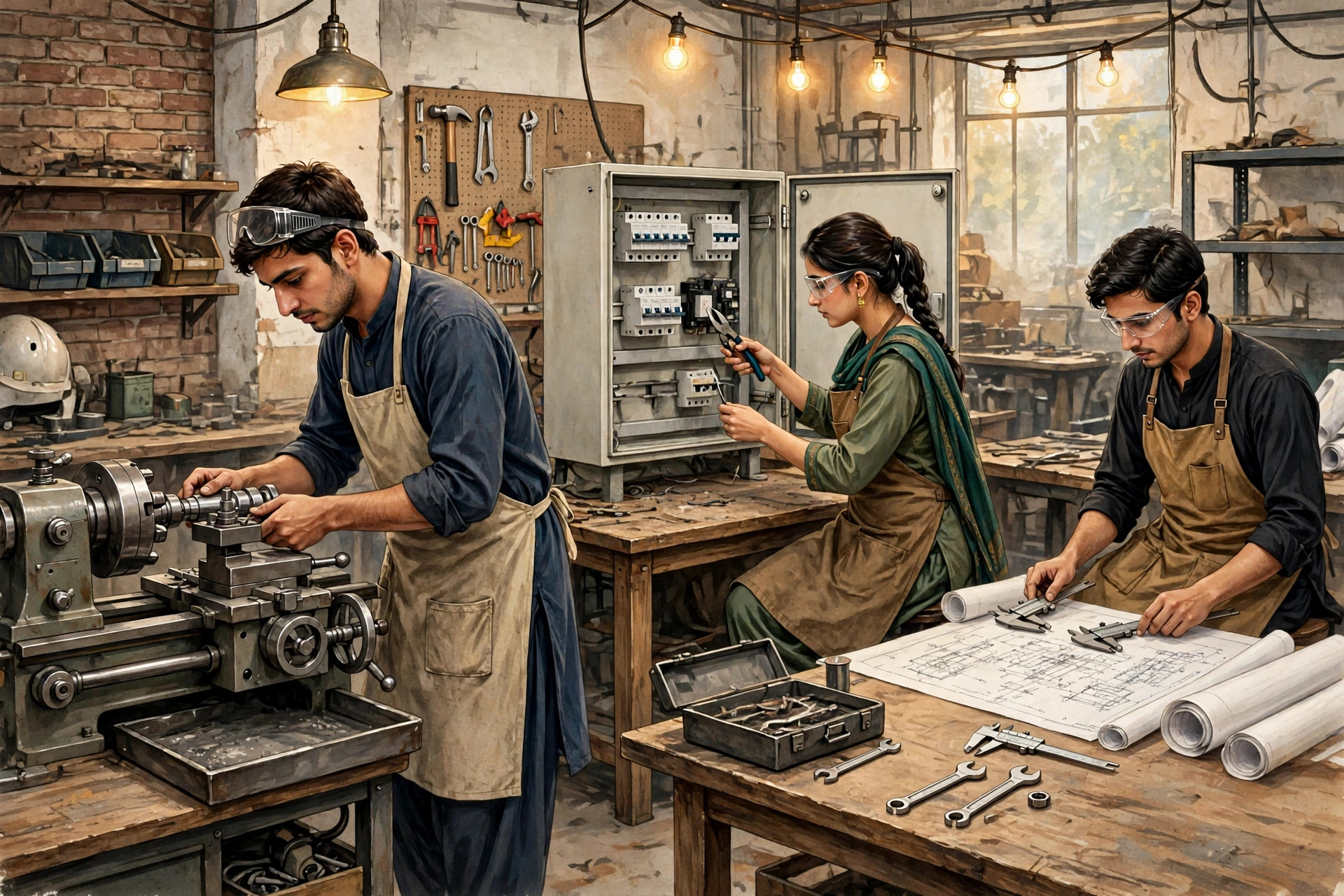
1. What DAE Actually Is (and What It Is Not)
DAE stands for Diploma of Associate Engineer. It is a three-year post-matric technical program regulated in Punjab by the Punjab Board of Technical Education (PBTE), Lahore, with sister boards in Sindh, KP and Balochistan, and delivered through government colleges of technology (GCTs), polytechnic institutes and private technical colleges. You enter after matric with science subjects; you leave three years later as a trained technician in one engineering technology — civil, electrical, mechanical, electronics, computer information technology and others.
What it is not: it is not a shortcut to calling yourself an engineer, and it is not an academic intermediate certificate. The boards treat the DAE as equivalent to FSc Pre-Engineering for admission into technology degree programs — TEVTA Punjab states this equivalence explicitly — but universities apply their own admission policies, so always confirm with your target institution. Think of the DAE as the practical track: where FSc teaches you the theory of physics, the DAE teaches you to wire the panel, pour the slab and machine the part. If you have read our guide to choosing between FSc, ICS and ICom, treat this article as the missing fourth chapter.
2. Who Should Do DAE: Eligibility in Plain Terms
The entry bar is straightforward. Almost every government institute requires matric with science subjects (physics, chemistry, mathematics) and a minimum of 45 to 50 percent marks. There is generally no entry test — admission is on matric merit, which means your science-subject marks decide not just whether you get in, but which technology you get. Electrical and civil fill up first at the big GCTs; students with lower merit take what remains.
Age rules vary by institute. TEVTA Punjab sets the morning-shift age limit at 25 years and allows up to 45 years in the second (evening) shift, while specialized institutes set their own caps — the Precision Systems Training Centre in Lahore, for example, caps applicants at 19. Domicile of the relevant province or district is usually required for government seats, and you will need your matric result card, B-form or CNIC, photographs and your father's CNIC at the time of application. Our domicile certificate guide covers that document end to end.
Who thrives in a DAE: students who like doing things with their hands, who scored decently in science but do not enjoy heavy memorization, and who want to earn sooner rather than spend six-plus years in university first. Who should skip it: students aiming for MBBS or competitive engineering seats through MDCAT and ECAT — for those, our MDCAT guide and ECAT guide are the relevant reads, and FSc is the cleaner route.
3. The Best DAE Technologies in 2026
A DAE is not one diploma — it is a family of technologies, and the choice matters more than the institute. Here are the main ones, with an honest read on each:
| Technology | What you learn | 2026 job market |
|---|---|---|
| Civil Technology | Surveying, construction drawings, quantity estimation, site supervision | Strong — construction, housing schemes, CPEC-linked projects and municipal works hire DAE civil holders as site supervisors and quantity surveyors |
| Electrical Technology | Wiring, power distribution, motors, transformers, control panels | Very strong — WAPDA distribution companies, private industry and solar installation firms all need electrical technicians |
| Mechanical Technology | Workshop practice, lathes, welding, dies and moulds, maintenance | Strong — factories, Pakistan Ordnance Factories, railways and Gulf employers recruit mechanical diploma holders steadily |
| Electronics Technology | Circuits, instrumentation, PLCs, repair and calibration | Good — industrial automation and instrumentation roles, though narrower than electrical |
| Computer Information Technology (CIT) | Hardware, networking, databases, basic programming | Growing — IT support, network technician and data-entry-adjacent roles; pairs well with freelancing skills from our online earning guide |
| Petroleum / Chemical Technology | Refinery and process-plant operations | Niche but well-paid — refineries, fertilizer plants and oil-field services; fewer seats, less competition |
| Architecture / Quantity Surveying variants | Drafting, AutoCAD, estimation | Good for self-employment — draftsmen with AutoCAD skills freelance for builders and architects |
The honest advice: electrical, civil and CIT have the widest markets because power, construction and IT touch everything. Mechanical is the Gulf-employment classic. Niche technologies like petroleum pay well but have few institutes and fewer total jobs. Choose the technology whose daily work you can picture yourself doing at 8 AM for years — not the one a relative calls most prestigious.
4. DAE vs FSc Pre-Engineering vs ICS: An Honest Comparison
Most matric students are really choosing between three paths. Here is how they compare on the things that matter:
| Factor | DAE | FSc Pre-Engineering | ICS |
|---|---|---|---|
| Duration | 3 years | 2 years | 2 years |
| Typical entry requirement | Matric science, 45–50%+ | Matric science, 60%+ at good colleges | Matric, ~50%+ |
| Learning style | Hands-on workshops + theory | Theory-heavy, memorization + numericals | Logic and computing theory |
| Job readiness after completion | High — employable technician skills | Low — needs a degree first | Medium — needs a degree or freelancing skills |
| Higher-study routes | BS Engineering Technology, BS Engineering (open merit routes), B.Tech | All engineering, CS, sciences, CSS | BS CS, software, IT, data science |
| Total cost (government) | Very low; fee waivers available | Low to moderate | Low to moderate |
| Best for | Students who want skills and income sooner | Students targeting competitive engineering seats | Students targeting software and IT degrees |
Notice the trade-off clearly. DAE gives you employability at 19 or 20 but narrows the academic ceiling unless you continue to a technology degree. FSc keeps every door open but earns you nothing until a degree follows. If your family's finances need you earning sooner, the DAE is not the consolation prize — it is the rational choice. For the full picture on the academic routes, see our career options after intermediate guide.
5. How Admission Works: TEVTA Punjab, PBTE and Private Colleges
In Punjab, the system has two moving parts. TEVTA (Technical Education & Vocational Training Authority) runs the 46 Government Colleges of Technology across 34 districts and handles admissions through its online portal at portal.tevta.gop.pk. The Punjab Board of Technical Education (PBTE) sets the examination and registration schedule that every affiliated institute — government or private — follows. For the 2026–27 session, admissions opened in August 2026, PBTE's single-fee admission deadline fell on 21 September 2026, and institutes completed registration formalities through October 2026.
The process at a government GCT is refreshingly simple: buy the prospectus (a few hundred rupees — GCT Sangla Hill charged PKR 355 for 2026–27), fill the form with your matric details, attach documents, and wait for the merit list, which is displayed on the college notice board and sometimes online. Interviews, where held, are scheduled by marks bracket. Private polytechnics affiliated with PBTE follow the same board schedule but run their own admissions — always verify a private institute's PBTE affiliation and your technology's accreditation before paying any fee, because an unaccredited diploma is three wasted years.
Outside Punjab, the pattern repeats with local bodies: the Sindh Board of Technical Education, KP's Board of Technical Education and Balochistan's directorate run their own schedules, and federal institutes like PSTC under PCSIR admit on their own merit or first-come basis. Wherever you apply, the annual rhythm is the same — admissions open mid-year after matric results — so start watching the portals in June and July rather than discovering deadlines in September.
6. Fees, Scholarships and the Real Cost of Three Years
This is where the DAE quietly beats almost every other option. Government colleges of technology charge only a few thousand rupees per year in tuition, and TEVTA Punjab's 2026 policy waives fees entirely for students who scored 90 percent or above in matric, with a 50 percent waiver for 80 to 89 percent. Add the prospectus fee, examination fees charged by the board each year, and your workshop material costs, and a full three-year DAE at a government college can cost less than one semester at a private intermediate college.
Private polytechnics are a different story — fees run far higher, sometimes past six figures per year. If you go private, calculate the total three-year cost including board exam fees and compare it against the government merit route before committing. Beyond TEVTA's waivers, look at our scholarships guide for need-based options, and note that NAVTTC's free short courses can add certified skills on top of your DAE during semester breaks. One warning: never pay an "agent" for a government DAE seat — admissions are merit-based and published on notice boards, and anyone selling a seat is running a scam.
7. What You Actually Study: Year by Year
A DAE is roughly half workshop, half classroom — that ratio is the whole point. In the first year you cover applied mathematics, applied physics, basic engineering drawing and your technology's fundamentals, alongside compulsory subjects. Expect to spend as much time in the workshop as in the lecture hall from the start: fitting shops, wiring labs and drawing halls are where the diploma is really earned.
The second year goes deeper into your technology — machines and measurements for mechanical, power systems for electrical, structures and surveying for civil — with industrial visits and longer practical sessions. The third year adds advanced subjects, project work and, at good institutes, industrial training or an internship with a local factory or utility. That final-year project and any internship reference matter enormously at job interviews: employers hiring DAE holders ask what you have built and fixed, not what you memorized. Treat every practical as a job interview rehearsal.
8. Jobs After DAE: Where Diploma Holders Get Hired
Here is the payoff. DAE holders are hired as technicians, sub-engineers, site supervisors, draftsmen, lab technicians and maintenance staff across a remarkably wide market:
- Government and public sector: WAPDA and the power distribution companies, Pakistan Railways, Pakistan Ordnance Factories, municipal corporations, irrigation and public-health engineering departments — all advertise technical posts specifically requiring DAE. These are the coveted permanent posts with pensions.
- Industry: textile mills, fertilizer plants, cement factories, refineries and the growing solar sector hire electrical and mechanical diploma holders for operations and maintenance.
- Structured trainee programs: public-sector organizations periodically run paid training schemes for DAE holders — recent mining and drilling trainee programs, for example, paid a monthly stipend around Rs. 37,630 during training with appointment at BPS-14 (Tech-I) grades afterward. Watch the jobs pages, not just the admissions pages.
- Gulf employment: mechanical, electrical and civil DAE holders have a long-established route to technician jobs in Saudi Arabia, the UAE and Qatar, where the diploma plus a few years of local experience converts into strong salaries.
- Self-employment: electrical DAE holders run wiring and solar-installation businesses; civil holders do quantity surveying and supervision for private builders; CIT holders do computer repair, networking and CCTV installation. The diploma plus a small toolkit is a complete business.
Starting salaries in Pakistan's private sector are modest — treat the first two years as paid experience — but government technical posts and Gulf placements change the picture fast. The diploma holders who earn the most are the ones who kept learning: AutoCAD for civil, PLC programming for electrical and electronics, and solar-system design, which is booming in 2026.
9. Higher Studies After DAE: Engineering Degrees and Beyond
A DAE does not end your education unless you want it to. The main routes upward:
- BS Engineering Technology: the natural continuation — universities across Pakistan admit DAE holders into four-year technology degree programs, and TEVTA advertises direct admission eligibility into BS Engineering and BS Engineering Technology on open merit for its graduates. Confirm the current policy with your target university, because institutional rules change.
- B.Tech (evening): the classic working-technician's degree — study in the evening while holding a day job.
- BS programs in related fields: depending on the university, DAE holders enter computer science, construction management and industrial technology programs; our HEC university rankings guide helps shortlist institutions.
- Professional certifications: short, high-value add-ons — HVAC certification, solar PV design, AutoCAD and Revit, Cisco networking for CIT holders — that multiply a DAE's salary faster than another degree.
One caution: if your dream is a PEC-registered BSc Engineering seat at a top university through ECAT, the FSc route remains cleaner — our ECAT guide explains why. But for students who want a respected technical career with the option to keep climbing, DAE-to-BS-Technology is a proven ladder that thousands climb every year.
10. The Mistakes That Waste Three Years
- Choosing the technology by hearsay: picking petroleum because an uncle mentioned it, without checking whether any institute near you even offers it well. Visit the workshops before you choose.
- Joining an unaccredited private institute: a DAE from a college not affiliated with the provincial technical board is worthless paper. Verify affiliation on the board's website before paying a rupee.
- Sleepwalking through practicals: the workshop is the degree. Students who coast through practicals graduate with a certificate and no skill — exactly the opposite of what employers pay for.
- Ignoring English and drawing: engineering drawing and functional English decide promotions more than any other subjects. Technicians who read drawings and write clear reports become supervisors.
- Paying agents for government seats: merit lists are public and published. Anyone charging for a GCT seat is scamming you — report them to the institute.
- Treating the DAE as the finish line: the diploma gets you the first job; certifications, a technology degree or Gulf experience get you the career. Plan the next step in your second year, not after graduation.
11. Your Application Checklist and Timeline
Admissions follow the same rhythm every year. Work it like this:
- June–July (right after matric results): shortlist 2–3 technologies using section 3, and 3–4 institutes — mix government GCTs with one accredited private backup. Check each institute's workshop in person if you can.
- Documents folder: matric result card, B-form or CNIC, father's CNIC copy, domicile certificate, and 8–12 passport photographs. Missing documents are the commonest reason applications get delayed.
- July–August: watch the TEVTA admission portal and your provincial technical board's website. Buy prospectuses early — merit lists are unforgiving of late forms.
- August–September: submit forms, track the merit lists on notice boards, and attend interviews in your marks bracket. Keep your backup institute's deadline in view.
- October: complete board registration formalities and fee submission by the PBTE schedule. You are now a DAE student — buy your drawing instruments and workshop shoes.
- First semester: aim for strong marks from day one. First-year grades feed your final division, and your final division feeds job applications and BS admissions alike.
The DAE is Pakistan's most underrated post-matric option: three years, minimal fees, real skills, and a direct line into jobs that FSc graduates queue behind you for. It is not for everyone — the academically ambitious aiming at medical and elite engineering seats should take FSc. But if you want to learn a trade the country actually pays for, walk into the nearest government college of technology this admission season and look at the workshops with your own eyes. The machines will tell you more than any brochure.
Frequently Asked Questions
What is DAE and is it equal to FSc in Pakistan?
DAE is the 3-year Diploma of Associate Engineer, a technical diploma taken after matric with science. The Punjab Board of Technical Education and TEVTA treat it as equivalent to FSc Pre-Engineering for admission into BS Engineering Technology and related degree programs, but it is a hands-on technical qualification, not an academic intermediate certificate. Confirm equivalence with your target university before admission.
What marks are required for DAE admission in Pakistan?
Most government polytechnic institutes require matric with science subjects and at least 45 to 50 percent marks, with merit lists going higher for popular technologies like electrical and civil. Some specialized institutes set higher cutoffs. Admission is usually on matric merit with no entry test, so your science-subject marks decide your technology.
Which DAE technology has the best scope in Pakistan?
Electrical, civil and computer information technology consistently have the widest job markets in Pakistan — power distribution companies, construction, and IT support all hire DAE holders. Mechanical stays strong in industry and the Gulf. Pick the technology whose daily work you can picture yourself doing for years, not just the one relatives call prestigious.
Can I do engineering after DAE in Pakistan?
Yes. DAE holders can apply for BS Engineering Technology and, through TEVTA-affiliated routes, BS Engineering programs on open merit. Many universities admit DAE graduates directly into the second year or into dedicated technology programs. Check the admission policy of your target university, because rules differ between institutions.
What is the fee for DAE in government colleges in Pakistan?
Government colleges of technology charge modest fees — typically a few thousand rupees per year plus a small prospectus fee. TEVTA Punjab offers a 100 percent fee waiver for students with 90 percent or more in matric and a 50 percent waiver for 80 to 89 percent. Private polytechnics charge much more, so compare total three-year costs before choosing.
Is DAE better than FSc for getting a job in Pakistan?
For immediate technical employment, DAE usually wins — you graduate with workshop skills employers can use on day one, and government technical posts specifically advertise for DAE holders. FSc wins for keeping academic doors open, especially medicine and competitive engineering. Choose DAE if you want skills and a job sooner; choose FSc if you want the widest range of degree options.
Seekho Learn Editorial Team — practical guides for students and young professionals.