
BISE Punjab Supplementary Exams 2026: Date Sheet, Roll Number Slips & Result Schedule (2nd Annual)
Failed a paper in the annual board exams, missed one, or fell short of the marks you need for your dream college or university? The good news is that Punjab's boards give you a second chance in the same year. The supplementary (2nd annual) examinations 2026 are the official makeup round for Matric and Intermediate students across all nine Punjab boards — and the schedule is already fixed: Matric supplementary exams began on 6 October 2026, while Intermediate supplementary exams start on 3 November 2026. This guide covers everything in one place: what the 2nd annual exams are, who is eligible, the complete 2026 date schedule, how admission works, how to download your date sheet and roll number slip, the exam-day rules, when results are announced, the improvement-of-marks rules, and a realistic preparation plan for the limited time you have. If you are appearing this season, read this before anything else.
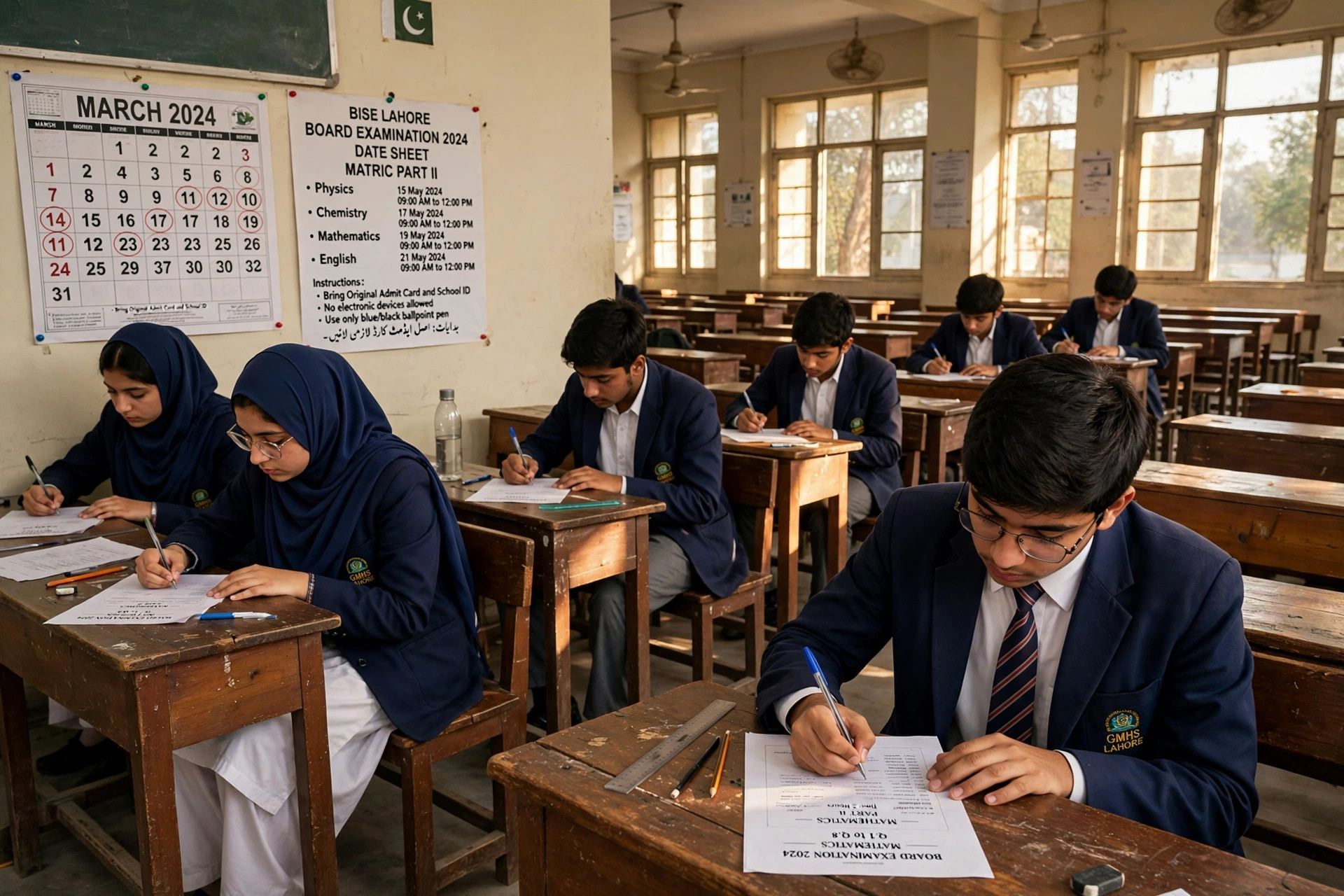
1. What the Supplementary (2nd Annual) Exams Actually Are
Punjab's Boards of Intermediate and Secondary Education (BISE) run two examination sessions each year. The 1st annual session is the main board exam round — Matric exams were held from 27 March 2026 and Intermediate exams from 20 May 2026 this year. The 2nd annual session, better known as the supplementary exams, is the second round held later in the same calendar year for students who did not clear everything in the first round.
The supplementary round exists for one practical reason: it stops a failed or missed paper from costing you an entire academic year. Before this system existed, a student who failed one subject in May had to wait for the next year's annual exams to reappear, losing twelve months. The 2nd annual session compresses that wait to a few months — you reappear in October or November, your result is out by December or January, and your college or university admissions continue with only a small delay. For intermediate students targeting university merit lists, this makes the difference between losing a year and losing a few weeks of the admission cycle.
One terminology note: boards now officially call these the 2nd annual examinations in their notifications, while students, teachers and news channels still say supplementary exams or supply exams. They are the same thing. Whenever you see either term on a board website or in a date sheet, it refers to this makeup round.
2. Who Is Eligible to Appear
You can appear in the 2nd annual exams if you fall into any of these categories:
- Failed students: you failed one or more subjects in the 1st annual exams and need to clear them. You only reappear in the subjects you failed — your passed subjects stay cleared.
- Absent students: you were registered for the annual exams but could not appear in some or all papers for any reason, including illness or emergencies.
- Improvement candidates: you passed but your marks or division are below what you need — for example, below a university's merit cutoff — and you want to raise them. Section 9 covers the improvement rules in detail.
Eligibility follows your existing registration: you appear with the board you were registered with in the annual session, and regular students apply through their school or college while private candidates apply directly. A student who passed everything and has no improvement need has no reason to appear — the 2nd annual session is not a third attempt for practice; it is a real exam whose result goes on your record.
3. Punjab Supplementary Exam Schedule 2026: All Key Dates
The Punjab boards announced the supplementary examination calendar as part of the official 2026 exam schedule, and it applies uniformly across all nine boards — Lahore, Gujranwala, Multan, Faisalabad, Rawalpindi, Sargodha, Bahawalpur, Dera Ghazi Khan and Sahiwal. No board sets its own dates for these sessions. Here is the complete picture for 2026:
| Level | Event | Date |
|---|---|---|
| Matric (9th & 10th) | 2nd annual exams started | 6 October 2026 |
| Matric (9th & 10th) | Result announcement | 8 December 2026 |
| Intermediate (11th & 12th) | 2nd annual exams start | 3 November 2026 |
| Intermediate (11th & 12th) | Result announcement | 12 January 2027 |
For context, the annual session that these supplement: Matric exams began on 27 March 2026 (moved from 3 March to accommodate Ramadan), with Class 10 results on 6 August and Class 9 results on 2 September 2026. Intermediate annual exams began on 20 May 2026, with the 1st-year result on 22 August and the 2nd-year result on 23 September 2026. That timing explains the gap: boards needed roughly six weeks after each result announcement to process supplementary admissions, allot centres and print roll number slips.
The most time-sensitive line in that table is the Intermediate one: exams begin on 3 November 2026. If you are an intermediate student appearing in the 2nd annual session, the remaining preparation window is measured in days, not months — which is exactly why section 10 exists.
4. How Admission for the Supplementary Exams Works
Admission for the 2nd annual exams follows the same route as annual admission, just on a shorter timeline:
- Regular students: your school or college submits your admission form to the board on your behalf. Stay in contact with your institution's exam office — they announce the internal deadline, which is always earlier than the board's final date, and they need time to process forms for the whole batch.
- Private candidates: you apply yourself through your board's online admission portal, filling the form, uploading the required documents and generating the fee challan for payment at the designated banks or digital channels.
- Fee windows: boards open admission with a normal fee, then a double-fee window, then a triple-fee window as the deadline approaches. Applying in the first window costs you the least; waiting until the triple-fee window can multiply your cost for no benefit.
Keep your admission receipt, challan copy and form number safe — you will need the form number or CNIC to download your roll number slip later, and the receipt is your only proof if any record goes missing. If your name, father's name or subjects on the admission form contain an error, get it corrected through your institution or the board immediately; errors on the admission form print onto the roll number slip and can cause problems at the exam centre.
5. Date Sheet 2026: How to Download It for Your Board
The date sheet tells you the exact date, day and session (morning or evening) of each of your papers. Each of the nine Punjab boards publishes its own 2nd annual date sheet on its official website, usually a few weeks before the exams begin. The download steps are the same pattern everywhere:
- Open your board's official website — for example, BISE Lahore students go to biselahore.com.
- Look for the Date Sheet or Downloads section in the main navigation.
- Select your class (SSC Part-I/Part-II for Matric, HSSC Part-I/Part-II for Intermediate) and the 2nd annual session for 2026.
- Download the PDF, save it to your phone, and print a copy to pin where you study.
Two warnings that save students every year. First, verify against the official website only: date sheet PDFs also circulate through school WhatsApp groups, academies and Facebook pages, and unofficial copies sometimes carry mistakes — a wrong paper date copied from a forwarded image is a classic way to miss an exam. Second, read the whole date sheet, not just your first paper: practical exams, if you have them, are scheduled separately, and the morning/evening session of each paper matters for your revision planning. Our guide to checking board results online also lists the boards and their official result channels, which overlap with the same official websites.
6. Roll Number Slips: When and How You Get Yours
Your roll number slip is your entry ticket to the exam hall — it carries your roll number, name, photograph, subjects, exam centre address and the session timings. Without it, you do not sit the paper, no exceptions.
- Regular students normally collect their roll number slips from their school or college a few days before the exams begin. Institutions announce the distribution date — do not wait for them to call you; go and ask.
- Private candidates download their slips from their board's official website, typically by entering their form number or CNIC in the roll number slip section.
The moment you receive your slip, check four things: your name and father's name spelling, your subjects, your exam centre address, and the photograph. Centre changes happen between sessions, so do not assume you are going to the same centre as the annual exams — visit the centre a day early if it is unfamiliar, so you know the route, the gate, and how long the trip takes. If anything on the slip is wrong, contact your institution or the board's facilitation centre immediately; corrections on the last day are painful and sometimes impossible.
7. Exam-Day Rules Every Student Must Follow
Boards are strict about exam-hall discipline, and violations can get a paper cancelled. The standard rules announced with Punjab board exams apply to the supplementary session as well:
- Bring your original roll number slip — laminated copies and phone screenshots are not accepted as substitutes at most centres.
- Arrive early: reach the centre at least 30 minutes before the paper starts. Latecomers may be refused entry once the paper begins.
- No mobile phones or smart devices: phones, smartwatches and electronic gadgets are prohibited inside the exam centre. Being caught with one — even switched off — can lead to disqualification.
- Follow the invigilator's instructions on seating, answer-book filling and extra sheets; sign the attendance sheet carefully.
- Carry the right stationery: blue or black ballpoint pens, and your geometry instruments on practical or mathematics days.
One more practical point: centres for supplementary exams are fewer than for the annual session, so your centre may be farther away. Plan transport in advance, especially for morning papers in winter — Punjab mornings in November and December bring dense fog, and fog-related delays are a real reason students miss papers every year.
8. How to Check Your Supplementary Result 2026
Matric supplementary results are scheduled for 8 December 2026 and Intermediate supplementary results for 12 January 2027. On result day, boards release results through the same channels used for annual results:
- Official board websites: enter your roll number in the result section. Expect heavy traffic on announcement day — if the site does not load, wait and retry rather than trusting third-party result pages that may show stale or wrong data.
- SMS codes: each board operates an SMS result service — you send your roll number to the board's code and receive the result by text. This is the most reliable option when websites are overloaded.
- Result gazettes: boards publish downloadable gazettes; schools and colleges use these for official records.
Our detailed walkthrough of checking board results online, by roll number and SMS covers each board's website and SMS method step by step — the process for supplementary results is identical, only the date changes. After the result, download or screenshot your online result card immediately, and collect the official result card from your institution or the board, since universities and employers ask for the original during admissions.
9. Improving Your Marks: What the Rules Say
Supplementary exams are not only for failed students — they are also the official route to improve your marks or division. This matters most for intermediate students whose annual result fell below a university's merit requirement, and for matric students aiming at competitive college admissions.
The general framework, per board admission notifications:
- Who can improve: students who passed the annual exams but want better marks in specific subjects or a better overall division.
- Which subjects: improvement is usually offered per subject — you choose the papers you want to reappear in rather than retaking everything.
- What counts: board policies specify whether your improved marks replace the old ones only if they are higher, or unconditionally — this detail differs between boards and sessions, so read your board's current improvement notification before paying the fee.
- One-shot nature: improvement chances are limited; a wasted improvement attempt still consumes the opportunity, so only apply when you are genuinely prepared.
The honest advice: improvement only pays off if your preparation this time is meaningfully better than last time. Reappearing with the same study habits that produced the original result usually reproduces it. If the gap between your marks and your target is large, use section 10's plan rather than hoping the exam will be easier.
10. Preparing With Limited Time: A Smart Revision Plan
You do not have a full academic year — you have weeks. That constraint is actually an advantage if you use it right, because it forces you to study only what the exam rewards. Here is a focused plan:
- Diagnose first: pull out your annual exam papers or result breakdown and identify exactly which topics and question types cost you marks. Supplementary success comes from fixing specific weaknesses, not rereading entire books.
- Past papers over textbooks: board exams repeat question patterns heavily. Solve the last five years of past papers for each of your subjects under timed conditions — this is the highest-return activity available to you.
- Scheme and pairing: study the paper scheme (which chapters pair together in long questions) so your preparation targets the sections that actually appear.
- Write, do not just read: practice writing full answers by hand. Students who only read material freeze when they must produce a structured answer in the hall.
- Protect your health: the students who crash before supplementary exams almost always do it through all-nighters and skipped meals. Steady sleep beats heroic cramming.
Go deeper with our study guides: how to prepare for board exams for the full exam strategy, the one-month preparation plan which maps well onto a short supplementary window, effective study techniques and memory techniques for retaining more in less time, note-taking methods for condensing each chapter into revision sheets, time management for building your daily timetable, and beating exam stress — because supplementary candidates carry more pressure than first-timers, and pressure mismanaged becomes marks lost.
11. Common Mistakes That Cost Students a Whole Year
Every supplementary session, capable students lose their second chance to avoidable errors:
- Missing the admission deadline — supplementary admission windows are short. Students who assume the timeline matches the annual session discover the triple-fee window has closed.
- Trusting forwarded date sheets — arriving on the wrong day because a WhatsApp-forwarded date sheet had an error. Always verify against your board's official website.
- Not checking the roll number slip — a wrong subject or centre discovered at the exam gate is often unfixable on the day.
- Studying everything instead of the weak areas — rereading chapters you already passed while the failed topics get the same shallow treatment as last time.
- Carrying a phone to the centre — even an unused phone found during checking can cancel your paper.
- Ignoring the improvement rules — applying for improvement without reading the policy, then discovering the result treatment was not what you assumed.
- Letting shame slow you down — many students hide their supplementary status and study alone instead of asking teachers for help. Teachers have guided hundreds of supplementary candidates; their targeted advice is worth weeks of solo effort.
12. Your Action Plan for the Next Two Weeks
Here is the sequence, starting today:
- Today: confirm your admission status with your school or college (or on the board portal if you are a private candidate). Download the official date sheet from your board's website and print it.
- This week: collect or download your roll number slip, verify every detail on it, and locate your exam centre. Build a day-by-day revision timetable from the date sheet backwards — most hours to the weakest subject.
- Every day: solve at least one past paper per subject under timed conditions, and write out the answers by hand. End each day by listing the three topics that still feel shaky.
- The night before each paper: pack your slip, pens and instruments; set two alarms; sleep at a normal hour. A clear head outperforms one more chapter read at 2 a.m.
A supplementary exam is not a verdict on your ability — it is a scheduling problem with a study plan attached. Thousands of students clear their papers in the 2nd annual session every year and move on to the colleges and universities they wanted. Follow the dates, respect the rules, fix the specific weaknesses, and this session becomes a footnote in your story rather than a lost year.
Frequently Asked Questions
What are BISE supplementary exams?
Supplementary exams, officially called the 2nd annual examinations, are a second attempt offered by Punjab boards to students who failed subjects, were absent, or want to improve their marks or division. They let you clear your result without waiting a full year for the next annual session.
When do the Punjab board supplementary exams start in 2026?
Matric (9th and 10th) supplementary exams started on 6 October 2026, with results due on 8 December 2026. Intermediate (11th and 12th) supplementary exams start on 3 November 2026, with results announced on 12 January 2027. The schedule is uniform across all nine Punjab boards.
Who is eligible for the 2nd annual exams?
Students who failed one or more subjects in the annual exams, students who were absent, and students who want to improve their marks or division can all apply. Admission is submitted through your board, usually via your school or college for regular students and online for private candidates, within the announced fee windows.
Is the date sheet the same for all Punjab boards?
Yes. All nine Punjab boards — Lahore, Gujranwala, Multan, Faisalabad, Rawalpindi, Sargodha, Bahawalpur, Dera Ghazi Khan and Sahiwal — follow the same examination calendar. Each board publishes the date sheet on its own official website, but the exam start dates are identical.
How do I download my roll number slip for supplementary exams?
Regular students usually receive their roll number slips through their school or college before the exams. Private candidates download theirs from their board's official website using their form number or CNIC. Download it early and check that your name, subjects and exam centre are correct.
Can I improve my marks through the supplementary exams?
Yes, boards allow students to improve their marks or division through the 2nd annual exams, subject to each board's improvement policy. Rules about how many subjects you can improve and whether a lower score replaces your old one differ slightly, so read your board's improvement rules in the official admission notification before applying.
Seekho Learn Editorial Team — practical guides for students and young professionals.